Last month, on August 18, Three Forks' Zoning and Planning Board met at City Hall on Main Street to keep working through a project that's been running for years now: rewriting the town's zoning code, chapter by chapter, from the ground up. It's slow, unglamorous work. But if you're weighing a move to Three Forks because Bozeman's prices have priced you out, this meeting matters more to your decision than the last median-price chart you looked at.
Here's why. Beyond the price gap between Three Forks and Bozeman, the town's ongoing zoning-code rewrite may affect the mix of housing available in the years ahead. Understanding that process adds context the median price alone can't: what you're buying at that lower number, and how the choices available could change.
The number everyone quotes, and what it's built on
The 2026 Gallatin Valley Housing Report, presented by the Southwest Montana Association of Realtors and the University of Montana's Bureau of Business and Economic Research, put Gallatin County's median home price at about $800,000, roughly double where it sat in 2019. Bozeman and Manhattan share that $800,000 figure. Belgrade runs just under $600,000. Three Forks sits at the bottom of the county alongside West Yellowstone, with a median close to $450,000.
That's the headline everyone repeats: Three Forks costs roughly half of Bozeman. The headline doesn't show how the housing mix differs between the two markets, or how much Three Forks' median can vary depending on which month you check it.
A 2022 study examined local housing needs
A Three Forks Voice report covered a January 2022 presentation to the Three Forks City Council of a study by Future West and the One Valley Community Foundation. The study found that the town needed somewhere between 94 and 217 new homes by 2026 just to keep pace with regional job growth. Randy Carpenter, the city's planning consultant at the time, said the zoning code made affordable housing harder to build.
"We make it harder to build cheaper housing, the more affordable housing."
— Randy Carpenter, quoted in Three Forks Voice
The council's response, in the months after, was incremental. That July, it approved a conditional-use permit for a duplex on Jefferson Street, a small in-town infill project the mayor called a nice addition. The city also released a Growth Policy Plan meant to encourage more planned residential development going forward. Those were real steps. They were not a rewrite.
Acreage subdivisions shape the current mix
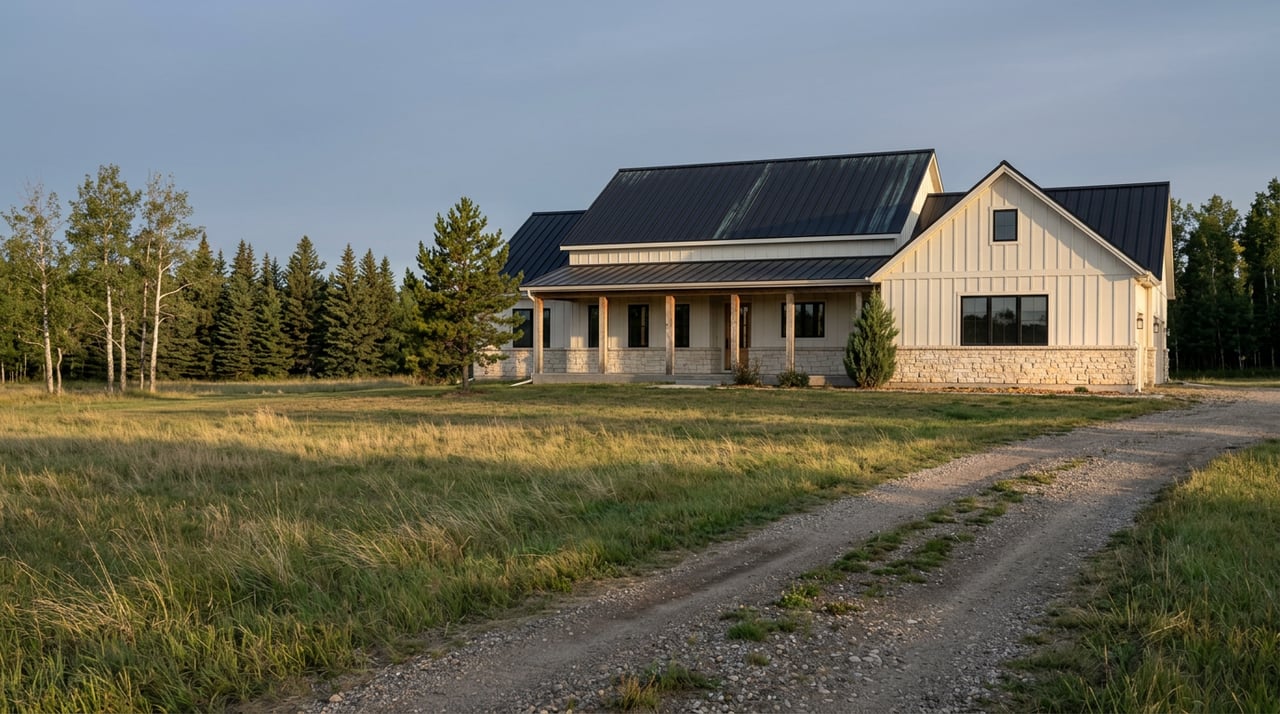
Walk the list of what's actually available in Three Forks today and a pattern shows up fast. Wheatland Meadows is a 320-acre subdivision with lots running one to five-plus acres, horses allowed on the larger parcels, and an HOA with covenants and annual dues. The Village at Elk Ridge, off Highway 287, offers similarly large single-family lots, mostly new construction, next to the Copper City Trail system's more than 17 miles of bike trail. Westside Trails and Morning Sky Estates follow the same script: acreage parcels a short drive outside town, priced for buyers who want space and don't mind the extra distance.
| Subdivision | Typical lot size | Character | HOA |
|---|---|---|---|
| Wheatland Meadows | 1 to 5+ acres | Open ag land, horses allowed on larger lots | Yes, covenants and dues |
| The Village at Elk Ridge | Roughly 1 to 3 acres | Near Copper City Trails, mountain views | Yes, covenants and dues |
| Westside Trails | Roughly 1 to 2 acres | Quiet, about 30 minutes to Bozeman | Varies by lot |
| Morning Sky Estates | Around 3 acres | Open rolling hills just outside town | Varies by lot |
These examples show the acreage-oriented housing available in Three Forks today. Separately, a 2022 study identified a need for additional homes, while the town's ongoing zoning-code rewrite addresses the rules that shape future housing options.
That distinction matters for a buyer comparing Three Forks to Bozeman on price alone. A $450,000 median in Three Forks and a $800,000 median in Bozeman aren't measuring the same kind of product. Much of the Three Forks number reflects acreage and distance. It doesn't reflect the smaller, in-town, walk-to-Main-Street inventory that would be the closer apples-to-apples comparison to a Bozeman starter home.
The county's 2025 building permit numbers provide another point of comparison. Bozeman logged 1,056 new units, mostly multifamily. Belgrade added 154, leaning single-family. Three Forks didn't register enough new permit activity to earn a mention in that same tally.
Why the median jumps around more than you'd expect
Three Forks is a small market. Annual closings run well under thirty homes a year, compared with more than 650 in Bozeman over the same stretch. When a market that thin sells a handful of large-acreage parcels or one custom home in a given quarter, the median price swings hard, sometimes by tens of thousands of dollars from one reporting period to the next. That's not a market correcting itself. It's a market too small for one quarter's number to mean much on its own.
For a relocator running comparisons between Three Forks, Belgrade, and Manhattan, the practical takeaway is simple: don't anchor to a single quarterly median. Look at what's actually closing inside the subdivision or price band you're shopping, and expect the town-wide number to move around underneath you as a handful of sales come and go.
What the rewrite could change
The Zoning and Planning Board's current work, still underway as of this August, is a full rewrite of the code chapter by chapter, not another round of one-off permit approvals. If it succeeds in loosening what's buildable inside town limits, the next few years could bring more in-town, smaller-lot product to Three Forks alongside the acreage subdivisions that already dominate the market. That would be a meaningful shift from what's on the market today, and it's the kind of change that shows up in inventory and pricing before it shows up in any headline report.
For a buyer today, that means the $450,000 median buys you space and river access at the confluence of the Jefferson, Madison, and Gallatin Rivers, not the compact, walkable inventory that a rewritten code might eventually allow. Neither is wrong. But they're different products, and knowing which one you're actually pricing out changes how you read every number you see.
FAQ
Is Three Forks a reliable lower-cost alternative to Bozeman right now? For the acreage and space it offers, yes. For an apples-to-apples comparison to a small in-town Bozeman home, less so, since most of what's currently available in Three Forks is the larger-lot subdivision product described above.
When will the zoning rewrite actually be finished? There's no published completion date. As of this August, the board is still working through the code chapter by chapter, and the pace has been measured in years rather than months since the issue was first raised in 2022.
If you're weighing Three Forks against Belgrade, Manhattan, or Bozeman proper and want a read on what's actually available right now, not just what the last quarterly median suggests, Chelsea Stewart Real Estate can walk you through the current inventory subdivision by subdivision. Request a free home valuation to start the conversation.
This article is general information, not legal, tax or financial advice. Consult a qualified professional about your situation.